Archaeology and Artefacts at Methil Mill
We have been working with local people to investigate the site of Methil Mill, which sits in the heart of the River Park. The mill is thought to date to the medieval period, and it is hoped that our investigations will reveal its date and evidence of the people who once lived and worked here.
Some of the site was excavated in 2004, so we know a bit about what it looked like and what kind of activities took place there, but there is still lots to discover. Our work has focused on re-excavating these areas, removing backfill from the earlier dig and exposing walls and floors once again. Finds from these deposits include 19th- and early 20th-century glass bottles, pottery, metal and wood, alongside material from the 1970s and 1980’s, when the area was used as a dump. This modern material has supported educational activities with local schools, helping young people understand more about recycling, waste, and environmental impacts.

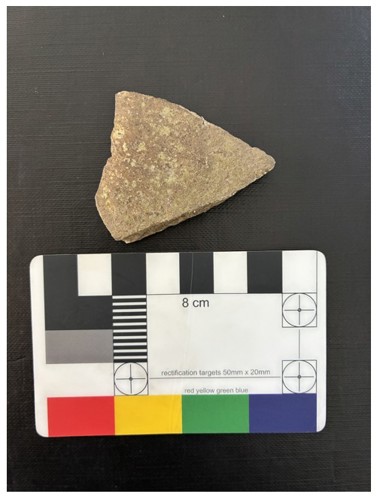 |
Between February and May, we delivered an employability project with local young people, using archaeology as a way to help them learn new skills and grow in confidence. As part of the project, we excavated two large trenches. The first trench was dug over a large mound which historic maps showed might have been the location of a building. However, excavation revealed that the mound was made up of twentieth-century rubbish that had been dumped there in the 1970’s, including bottles, toys, pottery, metal objects, and plastic. Beneath these modern deposits we found layers of sandy soil that contained groups of stones that may be the remains of former surfaces, or structures that had been demolished. A small piece of possible medieval pottery was recovered from between these stones, suggesting that older archaeological evidence survives below the later dumping. |
| Possible medieval pottery found in Methil Mill |
The second trench was in a wooded area, between the mill buildings and the new lade. Historic maps showed that this was an area that once had buildings, and we were interested to see if anything survived. We came across loads of rubble and demolition materials which covered what looks like building foundations and surfaces. We think that we only have the corner of the building, so we will expand this trench further over the next few months to find out its full extent. We found loads of artefacts in this trench, including 18th and 19th century glass and pottery, and we also found more fragments of possible medieval pottery, showing that the site was probably used for hundreds of years.
The employability participants learned excavation techniques using trowels, spades and mattocks, alongside manual handling skills as well as archaeological recording and report writing. All gained the Archaeology Scotland Heritage Hero Award and will undertake a week-long placement with a heritage organisation. The course will run again from February to May 2027, and places are still available, so get in touch if you or someone you know is interested.
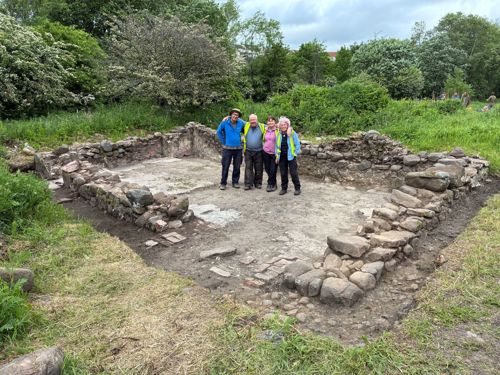 |
The project is also working with the Fife Fieldwork Archaeology Network (FFAN), a group of local archaeology enthusiasts. Together we have been excavating one of the buildings on site (Building 3), which appears to have been a workshop and possibly a house. Evidence suggests the structure was altered and repaired over time, and a piece of medieval pottery found within one of the walls indicates it may be one the oldest buildings on the site. We still have lots to do to record this building, and we are aiming to do this over the coming months. |
| Pround FFAN members in building 3 |
We have lots more to do at Methil Mill an opportunities to get involved are available during the weekends of 29–30 August and 26–27 September. If you would like to help uncover the history of Methil Mill, please get in touch.